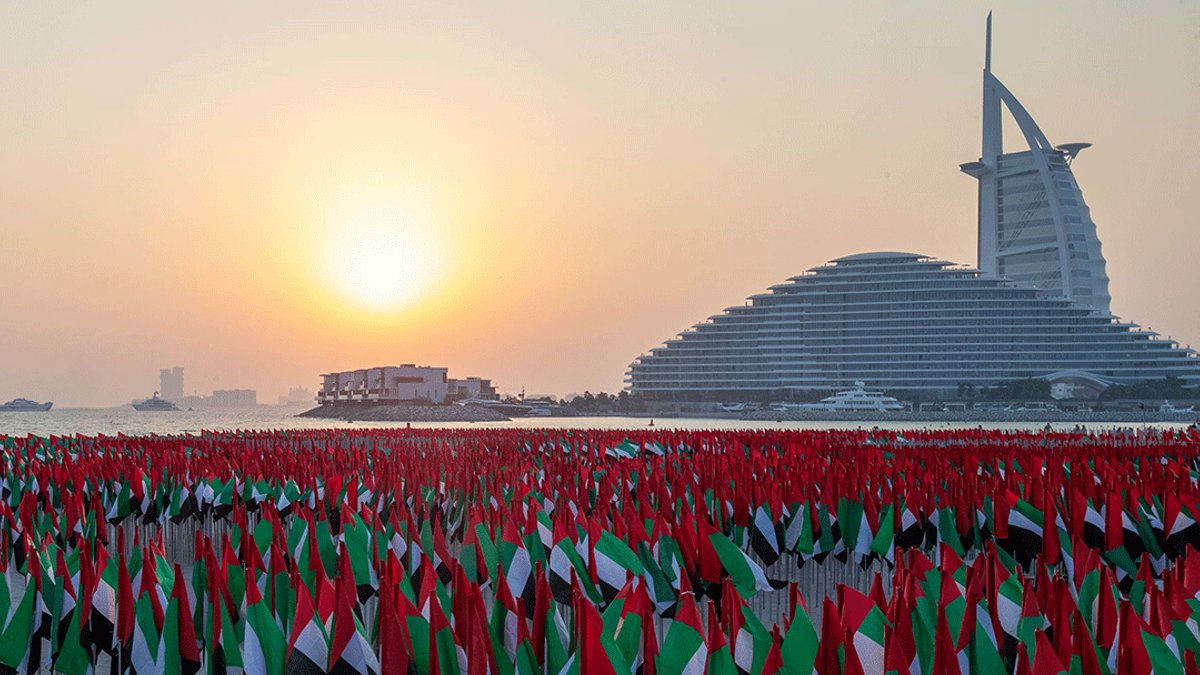
The UAE’s upcoming Flag Day is scheduled for November 3, 2026, though it will not provide paid leave for residents or employees. Introduced in 2013 by Sheikh Mohammed bin Rashid Al Maktoum, the observance commemorates the late Sheikh Khalifa bin Zayed Al Nahyan assuming the presidency in 2004. Unlike other national holidays, Flag Day remains an official observance without mandated closures, allowing businesses and markets to operate normally.
At 11 AM, government buildings, corporate offices, schools, and diplomatic missions across the seven emirates will simultaneously raise the national flag while playing the UAE national anthem. The ceremony emphasizes national unity and support for the country’s leadership and economic strategy.
The flag’s design, created in 1971 by Abdullah Mohammed Al Maainah, a 19-year-old Emirati, was selected from over 1,000 submissions. It was first hoisted by the late Sheikh Zayed bin Sultan Al Nahyan on December 2, 1971, marking the UAE’s formal establishment. The colors—red, green, white, and black—represent courage, prosperity, peace, and resilience, respectively.
Read Also: Carlyle still building Brooklyn portfolio
Symbolic ceremonies mark UAE’s unity
While the day does not grant paid leave, participation is extensive. Landmarks such as the Burj Khalifa, Dubai International Financial Centre (DIFC), and Abu Dhabi Global Market (ADGM) will host official ceremonies. Public displays, including the Flag Garden at Kite Beach in Dubai, will remain visible until UAE National Day on December 2. Companies also use the occasion to showcase civic involvement, reinforcing national development objectives.
Flag Day’s status as an observance rather than a holiday shows its symbolic purpose. Unlike UAE National Day, this event encourages collective engagement without disrupting economic activity. Most businesses and residents treat the day as a low-impact event, with operations continuing as usual. The focus shifts to flag-raising ceremonies and public displays rather than widespread closures. Its timing, just weeks before the holiday season, may also prompt some companies to use it as a preparatory marker for year-end activities.
The UAE’s approach to public holidays often balances national pride with economic efficiency. Flag Day’s lack of paid leave aligns with this balance, prioritizing symbolic cohesion over workforce adjustments. For now, November 3, 2026, will feature patriotic events rather than rest.
Public and private sectors sustain engagement
Public engagement remains strong despite the absence of mandatory leave. Schools, government agencies, and private firms typically organize small gatherings or digital campaigns to honor the occasion. The event’s timing also coincides with the lead-up to UAE National Day, allowing for extended displays of national pride across the emirates.
Read Also: Mamdani Starts Transfer Program Amid Reality Check
Historical records show the flag’s design process involved broad public input, reflecting the UAE’s commitment to inclusive national identity. The colors were intentionally chosen to represent shared values, with red symbolizing sovereignty and green standing for prosperity. White denotes peace, while black signifies resilience—a reminder of the nation’s enduring strength.
Corporate participation often includes employee-led initiatives, such as flag-raising competitions or charity drives. These efforts reinforce the day’s role as a platform for community involvement. The lack of paid leave does not diminish its significance, as the focus stays on collective expression rather than individual rest.
For residents, Flag Day serves as a reminder of the UAE’s founding principles. The observance aligns with broader national goals, including economic diversification and social cohesion.


